Creating Partners for Life: The Key to P1’s Success in the Demanding Data Center Market

P1 has been doing data center, or “advanced technologies” work for more than 15 years. By nurturing relationships, demonstrating flexible multi-trade capabilities, and delivering great results, P1 continues to become a trusted partner for large hyperscale data center and gigafactory customers.
And what happens when you do a good job? You’re asked to do more! These are the teams working on active data center projects in the Midwest, and the stories of how P1 has tackled tight turns and accelerated schedules.
NRD Confidential Data Center, Kansas City, MO (Mechanical Scope)
High expectations. High efficiency. High quality. These are just a few phrases that describe what it’s like to work on a project like NRD, a 500-acre data center campus.
“When it comes to the actual work in the field, hyperscale project installations aren’t that different from traditional construction projects, there’s just a lot more of it,” Superintendent Cole Mescher said.
“It’s the fast pace and schedule-driven nature that makes the experience different from our traditional markets, and presents new challenges for this P1 team.”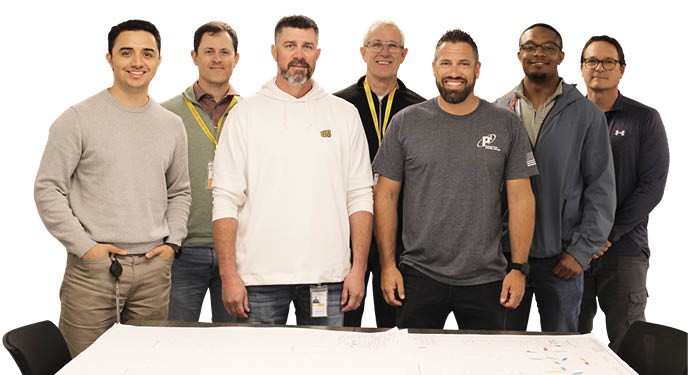
Pictured, from left: Parker Jenkins, Project Engineer; Garrett Parker, Mechanical Estimator; Mark McGrath, Senior Project Manager; Dan Tylski, Mechanical Estimating Manager; Cole Mescher, Superintendent; Ross Williams, Project Engineer (QA/QC); Kurt Glenn, Safety Contractor
The original project scope for one of the buildings was awarded to P1 in October 2025. Currently, P1 has mechanical work in both two buildings, with the P1 Building Technologies team completing work a third.
Keeping data center equipment just the right temperature for optimal performance requires a lot of cooling, and that is the main focus of P1’s mechanical team, including nearly 5.5 miles of process cooling water (PCW) piping.
“Once you’re in, and you perform well, you become a preferred contractor,” Project Engineer Parker Jenkins said. “GCs and owners are more likely to call upon us as a trusted trade partner in the future.”
Senior Project Manager Mark McGrath notes projects like this involve a lot more management.
“The owner is more demanding about what they want,” he said. “That’s the biggest difference. From preconstruction through scheduling, it’s fast, and it’s specific.”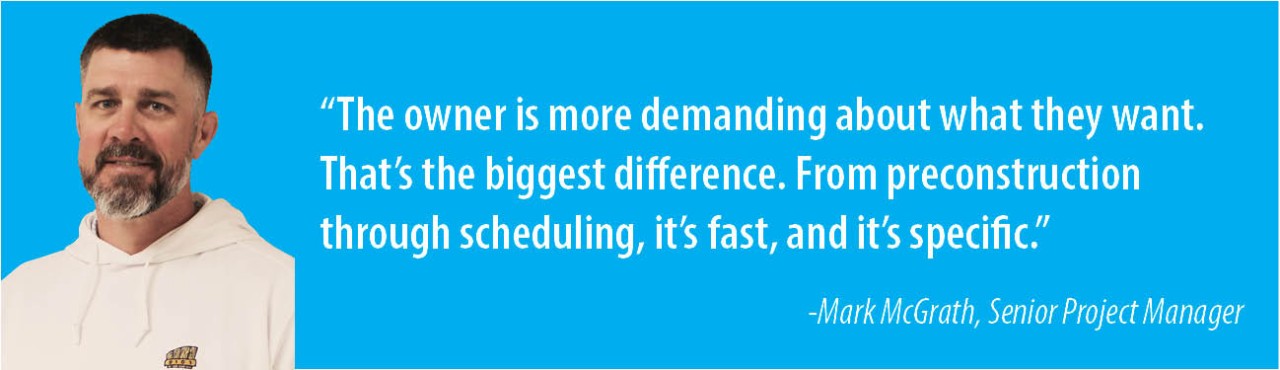
Virtual Design & Construction Specialist James Daugherty says the depth of the modeling process is also more detailed, but with more information available.
“Due to the replication of systems from data center to data center, there’s typically a model around from similar past projects,” he said. “We can see what’s been done and have an idea what they want at the outset.”
The team agrees, due to the expeditious nature, there’s a clearer picture and high level of organization when it comes to expectations, speed, and schedules, along with willful sharing of information along the way.
Part of P1’s vision statement says “our vision is to be the pioneering leader in construction innovation by empowering trusted partners”.
Mark says these large projects give a unique opportunity to partner not only with the owner and GC, but also with “competitors.”
“The owner drives a ‘lessons learned’ approach, and information has to be shared among trade partners,” he said.
“Everybody is open to this, and everyone just wants the project to succeed,” Cole said.
“P1 has always been an adaptable team player,” Cole added. “The owner sees us is one big team, competitors and all, so we need to play like one.”
“This kind of work is totally different, it brings the opportunity for more future work, and that’s a big draw for labor. People want to come work on the data centers,” he said.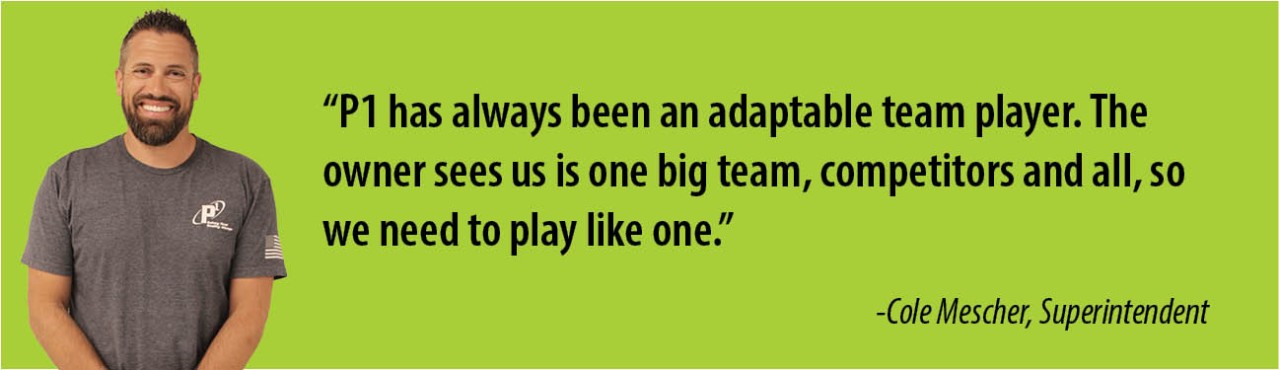
SAFETY FIRST, QUALITY ALWAYS
Safety Contractor Kurt Glenn notes that safety is taken seriously, and P1 appreciates the support from the Owner and GC.
“We are getting a lot of positive feedback that our teams are doing really well in adhering to the stringent safety and quality requirements,” Kurt said.
Project Executive/Senior Project Manager Jason Quattlebaum notes that although the team has just started, P1’s commitment to “Safety First” is already getting recognition from the GC’s safety staff.
“In addition to excellent scores on safety evaluations, the P1 team continually receives positive feedback from the GC teams for the attention to detail and team player attitude of the entire staff,” Jason said.
P1 was even recommended for a Safety Spotlight feature due to the team’s innovation in developing a trailer loading system with trade partner Thermacor. The feature spotlights the efficiency and safety the system has created for unloading on site.
“It just goes to show that what P1 might consider ‘normal’ work practices are seen by others as going above and beyond,” he added.
“For some of us, this is a first opportunity to see what this work is like,” Mark said. “Seeing it on paper is completely different than seeing it out there, and we’ll come away with new ways to do things.”
NRD Quick Facts
- Approx. 30k ft. of 10” to 20” PCW piping (about 5.5 miles)
- Approx. 6.5 acres under each of the five data center building roofs
- 12 Modular Central Plants
- 6400 ft. of server racks in each building
- Est. Completion: August 2027

The Installation Work Package (IWP) approach at hyperscale projects like NRD and KNC is a relatively new process to P1, and P1 teams were more than up to the task, developing tools to meet the needs of this approach and increase P1’s overall success.
Simply put, an IWP is a “mini project in a box”.
P1’s electrical teams with more data center experience have led the charge on managing IWPs, with the mechanical team learning the process through NRD.
“The IWP process entails creating sub-areas of the project, dividing up the major areas into manageable sections, and is based on geography and specific work scopes,” Project Engineer Parker Jenkins explained.
Once logical sub-areas have been created, IWPs are created within each sub-area. Each IWP is roughly the amount of work a single crew doing one type of work can complete in one week. For example, a crew of six working 58 hour weeks installing conduit will expend 358 labor hours. This would represent a single IWP.
“It’s a good way to plan a project out, be as productive as possible, and know what’s coming months in advance,” Parker added.
According to Director of Advanced Technology Craig Fritts, P1 has been extremely successful working with IWPs, due to P1’s ability to develop effective tools.
“IWPs are one of the most interesting new things we’ve been faced with on these projects, and the team has been crushing it,” Craig said. “We might even be the best MEP contractor in the country for implementation of IWP.”
The pilot of “MEP Tools”, led by Construction Technology Manager Jeff Peterson, has been instrumental.
“The team is currently piloting a custom-built field operations platform that tracks labor time, manages work packages, and delivers real-time analytics for large-scale projects,” Jeff said.
“By using a platform that aligns the schedule with IWP assets, timekeeping, and IWP lifecycle management - all of which incorporates with COINS and P1’s cost code structure – P1 has created a truly integrated process that meets the intent of the mandate,” Craig said.
“This gives us deep insights into labor efficiencies through our labor analytics and metrics, so we can more accurately forecast and understand trends for future work.”
KNC Confidential Data Center, Kansas City, MO (Electrical Scope)
Even though P1 teams have been working on data center projects for nearly two decades, KNC marked a milestone for P1 as the first project with this client in which P1 was awarded the entire electrical scope of work for building, not just select areas.
Much like P1’s other hyperscale work, the fast pace drives the need for a different approach to everything from managing the large P1 team on site to executing the Installation Work Packages (IWPs).
When the project mobilized in December, P1 didn’t have a trailer yet, but Senior Project Manager Kaleb Smith says some of the team stayed in the hotel space across the street.
Kaleb says even for data center work, this one was a fast shotgun start that had P1 on its toes from the outset.
“Even without our office space, it was important to get everyone familiar with the site, understand client expectations, and establish the rapport with our GC counterparts,” Kaleb said.
With or without a trailer, work was already underway, and the team was pulling tools and equipment from their truck beds to hit the ground running.
“I look back on the last eight months and I’m still amazed it all came together with as few bumps as it did, given all the new faces, and the fact that construction actually started very early,” Director of Advanced Technology Craig Fritts said.
“This required next-level patience on the part of the project team and support staff as we worked through the various issues that popped up.”
Senior Superintendent Corbyn Schuler boils down hyperscale client priorities to safety, speed, and quality.
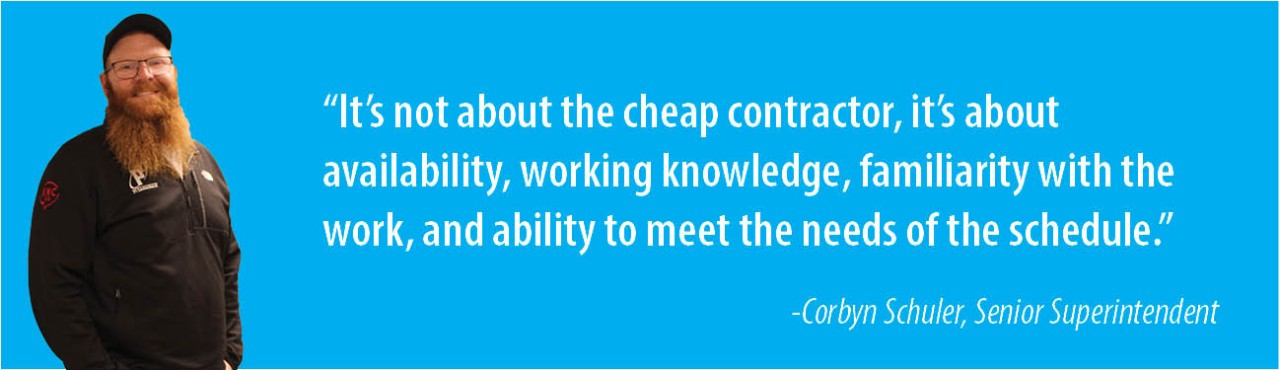
“It’s not about the cheap contractor, it’s about availability, working knowledge, familiarity with the work, and ability to meet the needs of the schedule,” he said.
“The only time money comes into the conversation is ‘how much is it going to cost to do this faster?”
The KNC3A team is sizeable, so management of the team becomes as important as the construction work itself.
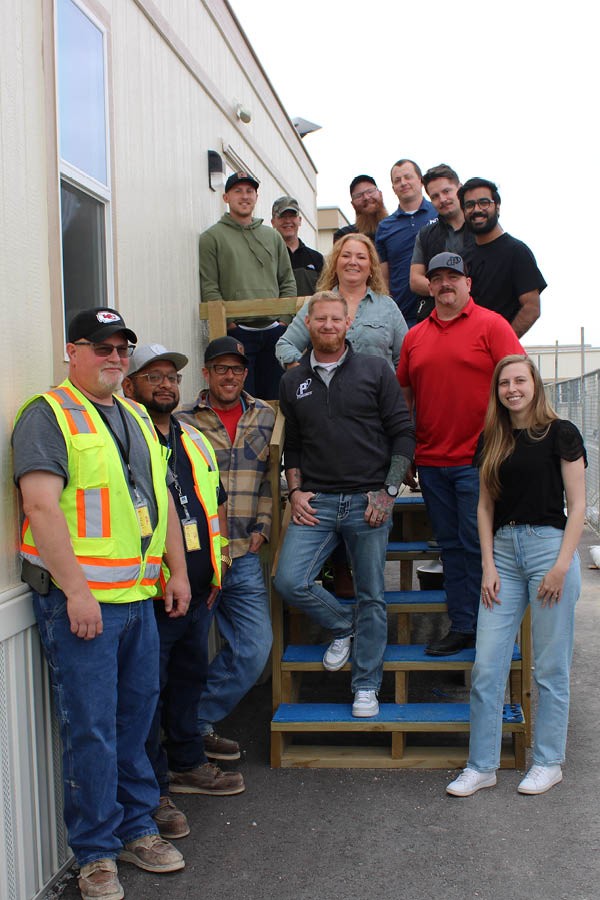
Pictured, front, from left: Travis Ueligger, FSA General Foreman; Rico Rodriguez, QA/QC General Foreman; John Barzack, EYD/MYD General Foreman; Kaleb Smith, Team Lead/Senior Project Manager; Mark Grant, Project Manager; Izzy Zimmerman, Office Coordinator; Center: Tennille Tegeler, Training Specialist; Back, from left: Cole Smith, Project Engineer; Craig Fritts, Director of Advanced Technologies; Corbyn Schuler, Site Superintendent; Bryan Bahr, Electrical Preconstruction Manager; Collin Blatchford, On-site VDC Specialist; Raja Humair, Project Scheduler
“What makes us successful is setting clear expectations up front, and making sure the team understands that accountability is the driver of profitability,” Kaleb said.
“While we’re implementing practices based on lessons learned from past projects, we also want to make sure every team member knows they have a voice,” he added.
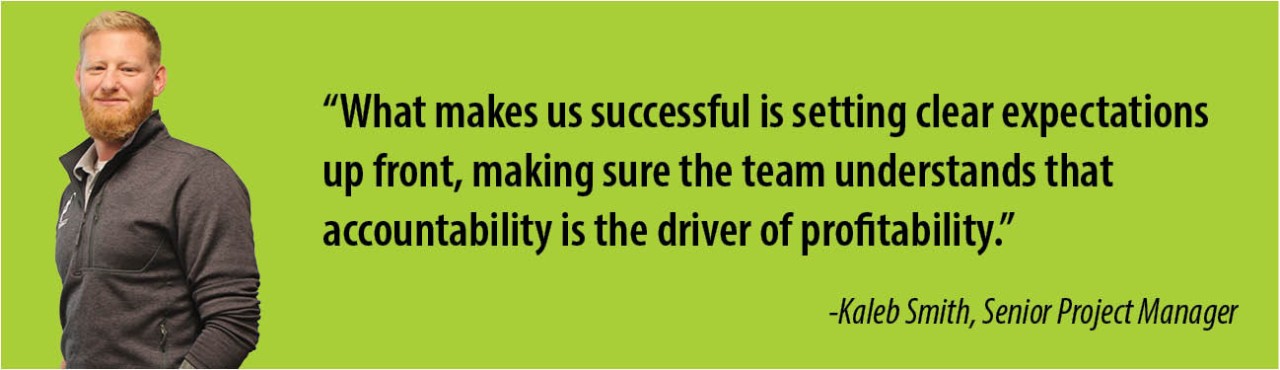
“Everyone has different ways to do things that could be just as good - or better - as the way we did it before.”
“We are vulnerable and transparent with each other, because that’s how we’re going to succeed,” Project Manager Mark Grant said.
“We all come from very different trade backgrounds, but ownership of mistakes and victories helps us move forward and ensure we, as a team, are helping lift all members of the team.”
Project Manager Camden Wheatley notes the team’s camaraderie makes a big difference in helping P1’s next generation build their expertise.
“We have a young, hungry team that’s learning as we implement this project,” he said.
“I see this benefitting the company down the road. We are the next generation of leadership, and we’re not only learning how to execute, but learning how to do it in a way that fits the P1 culture.”
Corbyn explains that even though data center work seems “cookie cutter” the projects constantly bring new designs.
“As this job progresses, we’ve been out at the P1 fabrication shop in Lawrence, working with the owner on how to eliminate parts of the planned design as it changes,” he said. “We’re constantly making changes, and we have to do it on the turn of a dime.”
Corbyn points out that the field is running at 100 miles an hour, and Kaleb says the office staff – from senior project managers to support – is there for one thing: to support the field.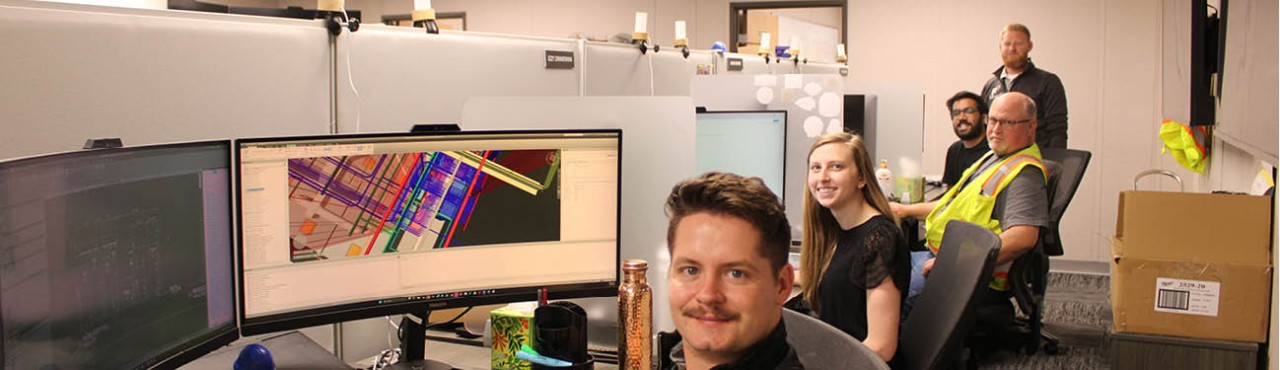
Pictured, above: Collin Blatchford ; Izzy Zimmerman; Travis Ueligger; Raja Humair, Kaleb Smith
“We’re not the ones performing the work, so our success doesn’t exist without our field talent. They set the tone and the standard. They tell us where to be and when,” Kaleb said.
Another aspect of hyperscale work “outsiders” don’t understand is the amount of teamwork required between more than just one organization.
That can include sharing information with everyone, from competitors to completely separate project sites.
“People don’t see the sheer inclusion and amount of people that have to come together to make these projects work,” Corbyn said.
“Not only do we share lessons learned on this site, but with other sites we’re not even working on,” he added.
“Learning to work with that kind of cohesion, even when it’s a competitor, has boosted that skill set for our P1 team.”
Kaleb points out another reason P1 is successful in this market.
“Not every contractor can manage the culture it takes on site to support the demands of these projects,” he said. “It’s only a handful of contractors, like P1, that can support the demand.”
Kaleb cites P1’s open-mindedness as a prime example of that culture.
“Leadership at P1 is open and willing to really listen and implement valuable input,” he said. “And the field has the ability to manage up.”
“We’re coordinating VDC, fabrication, Millwrights, construction,” he added.
“The fact that we are able to communicate and coordinate successfully across all parties and divisions of P1 is probably the biggest achievement accomplished on this project,” Kaleb said.
“If one trade or division of P1 fails, we’ve all failed.”
The question of “when do you need it” in the hyperscale world is always NOW.
From the office to the field, and in just a short amount of time, P1 has learned what it takes to deliver projects of this nature and adapted quickly, helping others along the way to understand and adapt as well.
And that’s how you become a pioneering leader, creating partners for life.
KNC Quick Facts
- Size: 80 megawatt (one building)
- 15.5 miles of 15kv cable
- 2,800+ light fixtures
- 66 skids (40 ft. x 8 ft.) for exterior switchgear
- 4+ miles of cable tray
- Est. Completion: July, 2027
The EXPERTISE of many, the POWER of ONE
P1’s Building Technologies Division is doing work on both NRD and KNC data center buildings.
Senior Integrated Solutions Manager Travis Fleming explains how P1’s off-site manufacturing has made their work at NRD more efficient.
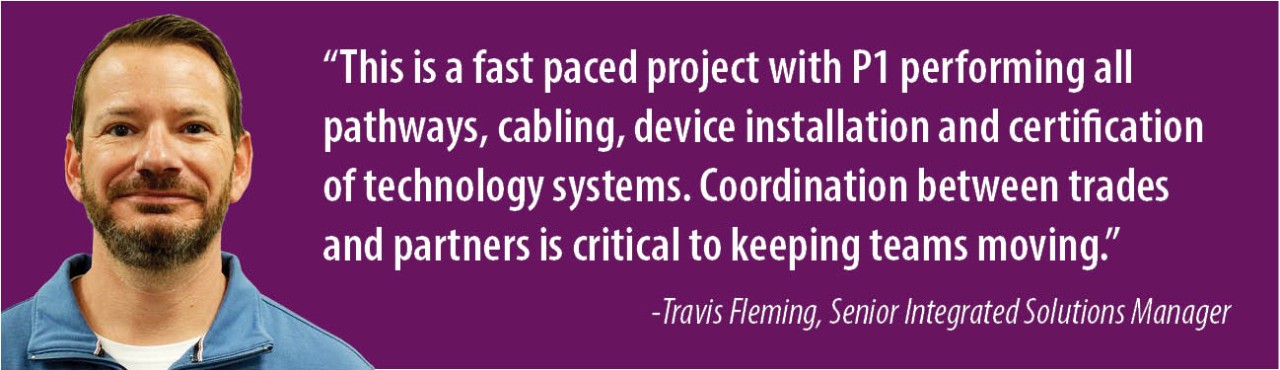
“Scott Bond Jr. and his team in P1’s electrical shop fabricated basket tray hangers and door kits for security systems, making installation in the field faster and safer.”
“This is a fast paced project with P1 performing all pathways, cabling, device installation and certification of technology systems so coordination between trades and partners is critical to keeping teams moving efficiently.”
“I think the GC realizes and appreciates our ‘single source’ capability for executing mechanical, electrical, plumbing, sheet metal, and millwright work,” Director of Advanced Technology Craig Fritts said.
“There are very few subcontractors that have this global MEP capability in the industrial space, and when a GC can minimize the number of subcontractors they have to manage, it alleviates a substantial amount of work and risk.”
Building Technologies Quick Facts
NRD (1A)
- 70k+ on-site hours for technology systems
- 2,200 Cat6 drops for technology systems
- Installation of over 11k of basket/ladder tray to support cabling systems
- Fusion Splice Termination of 6k fiber optic strands and installation of hundreds of pre-terminated fiber optic cables
KNC (3A)
- Fiber backbones
- Patching and certifications from the e-houses to the Unit Substation Switchgear (USS)
- Power Module Distribution Center (PMDC) and generator equipment in the electrical yard and the Power Distribution Center (PDC)